If you try to find out what property prices in Herceg Novi are today, you will quickly run into a problem.
There is no single price.
You can look at official statistics, browse listings on several property portals, ask a real estate agent or a neighbour who recently sold an apartment — and get completely different answers.
And each of them may be right in its own way.
According to Estitor, in the second quarter of 2026, the average asking price for an apartment in Herceg Novi was €3,190 per square metre.
A year earlier, it was €2,893.
That is an increase of roughly 10% in one year.
It all seems straightforward.
But what exactly does €3,190 mean?
Is an apartment in Igalo, one kilometre from the sea, really part of the same market as an apartment in Savina, 200 metres from the coast?
Are an older apartment requiring renovation and a new apartment with a garage really the same market?
Should a ground-floor apartment with no view and a top-floor apartment overlooking the bay cost the same simply because they are located in the same municipality?
Obviously not.
That is why the average price per square metre tells us considerably less about the market than it may initially seem.
First, What Exactly Are We Measuring?
There are official statistics from MONSTAT.
But there is an important qualification.
MONSTAT calculates prices for apartments in new developments where purchase agreements have been concluded with developers. The secondary market is not included in these statistics.
Moreover, there are no separate figures for Herceg Novi. The statistics cover Montenegro’s Coastal Region, which includes Herceg Novi together with other coastal municipalities.
So the data are useful.
They simply answer a slightly different question from the one we are asking.
Then there is Estitor.
Here we can look specifically at Herceg Novi. For the second quarter of 2026, the portal reports 1,343 active listings.
And that figure raises questions.
I know the size of the local market well enough to understand that there cannot realistically be 1,343 different apartments simultaneously for sale in Herceg Novi.
Realitica produces even more impressive numbers — several thousand listings.
But there are certainly not several thousand apartments actually on the market here at any given time.
In my estimate, the real number of unique apartments genuinely available for sale at a particular moment is more likely to be around 150–200 properties, rather than thousands.
So where do all those thousands of listings come from?
The explanation is simple.
The same apartment may be listed simultaneously by five, ten or sometimes even more agencies. Each agency publishes its own listing.
Then there are old listings for properties that have already been sold or withdrawn from the market. Some are simply never removed. Others remain on property portals long after the apartment itself has disappeared from the market.
There are also listings that remain online primarily as a way of attracting potential clients rather than as offers for properties that are actually still available.
So 3,000 listings do not necessarily mean 3,000 apartments.
And even 1,343 listings do not necessarily mean 1,343 apartments.
That distinction matters when we start calculating average prices.
Have Prices Really Increased by 130%?
Yes.
The figure looks almost unbelievable, but it is real.
In the first quarter of 2020, the average price per square metre for a newly built apartment in Montenegro was €940.
In the first quarter of 2025, it was €2,158.
That is an increase of 129.6%.
In other words, roughly 130% in five years.
But it is important not to draw a bad conclusion from good statistics.
This does not mean that every apartment in Herceg Novi increased in value by 130% over five years.
Nor does it mean that the Herceg Novi market as a whole increased by exactly 130%.
This is the change in the average price of new-build apartments across Montenegro.
The coast followed its own trajectory. The secondary market followed another. Herceg Novi had its own dynamics. And an individual apartment may have behaved differently again.
Nevertheless, the overall trend is clear.
Property prices have risen substantially in recent years.
Now let us try to understand what property actually costs today.
Herceg Novi Is Not a Single Market
According to Estitor data for the second quarter of 2026:
| Area | Average asking price |
|---|---|
| Meljine | €4,173/m² |
| Njivice | €3,949/m² |
| Savina | €3,665/m² |
| Đenovići | €3,443/m² |
| Baošići | €3,393/m² |
| Igalo | €3,238/m² |
| Kumbor | €3,114/m² |
| Centre | €3,048/m² |
| Topla | €3,015/m² |
| Kamenari | €2,962/m² |
| Bijela | €2,868/m² |
| Gomila | €2,089/m² |
This produces an interesting result.
Meljine — €4,173.
Gomila — €2,089.
The difference is almost twofold.
And both are within the same municipality.
But even here, I would not rush to conclude that a square metre in Meljine genuinely costs exactly twice as much as a square metre in Gomila.
A handful of expensive apartments can significantly shift the average in a relatively small real-world sample. And when the same apartment appears several times on a portal through different agencies, the average also begins to reflect the structure of the listings themselves.
Property portal data are therefore useful.
But they should be treated as listing statistics, not as a census of apartments actually available for sale.
Proximity to the Sea and the View Both Cost Money
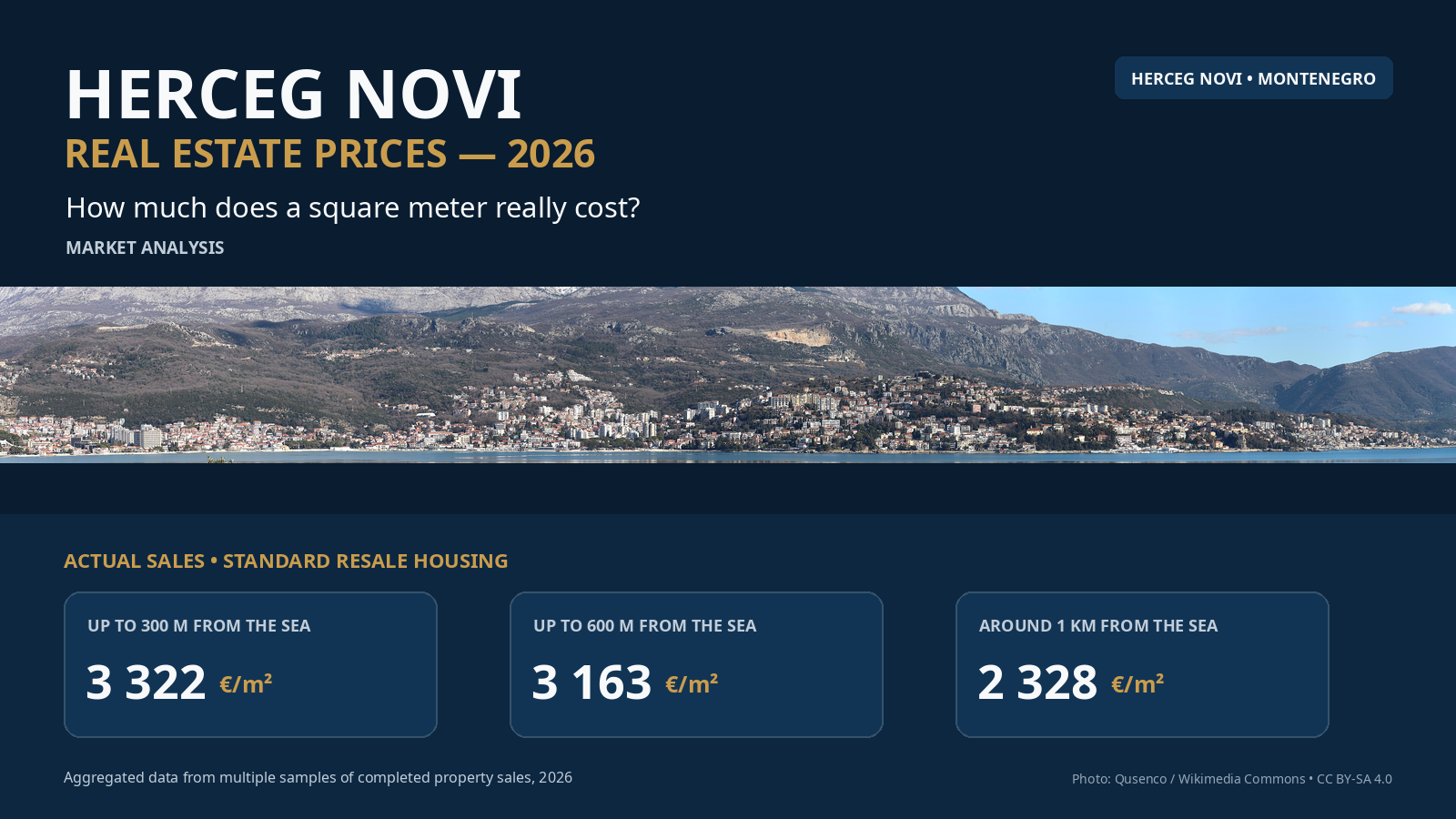
If we remove luxury properties, expensive new developments and other properties capable of significantly distorting the average, aggregated data from completed transactions involving ordinary secondary-market housing in 2026 produce the following picture:
up to 300 metres from the sea — €3,322/m²;
up to 600 metres from the sea — €3,163/m²;
around 1,000 metres from the sea — €2,328/m².
These are no longer sellers’ expectations.
They are aggregated data from several samples of actual completed transactions.
They are not official government statistics and do not claim to represent every sale in the municipality. But they allow us to look at the market from another angle.
And the picture is quite interesting.
Up to 300 metres — €3,322.
Up to 600 metres — €3,163.
The difference is less than 5%.
At around one kilometre — €2,328.
That is almost 30% below the first group.
But it would be too simplistic to explain this difference solely by distance from the water.
Because in Herceg Novi, both proximity to the sea and the view have a price.
And they are two different characteristics.
You can be very close to the sea and look directly at the wall of the neighbouring building.
Or you can be considerably higher up and have an unobstructed panorama across the entire Bay of Kotor.
The second property may well be more expensive than the first.
So distance from the sea works together with the view, elevation, accessibility and the quality of the property itself.
What About Luxury Property?
Until now, I have deliberately excluded luxury property from the calculations.
The reason is simple: if ordinary secondary-market apartments and expensive real estate are mixed into a single dataset, the average price quickly begins to lose its meaning.
But that does not mean luxury property is not part of the Herceg Novi market.
It is — and a significant one.
According to aggregated data from actual completed transactions in 2026, the average price per square metre in this segment is €5,309/m².
For comparison:
ordinary secondary-market property within 300 metres of the sea — €3,322/m²;
luxury property — €5,309/m².
The difference is almost 60%.
But here too, the word luxury by itself explains very little.
The price is no longer determined simply by floor area and distance from the sea. Waterfront location, unobstructed views, project and construction quality, architecture, the development’s infrastructure, swimming pool, garage, grounds, services and, ultimately, the address itself all matter.
So an apartment priced at €5,000–6,000 per square metre does not prove that “Herceg Novi now costs €5,000 per square metre.”
It proves something else:
within the same market, there are different segments with completely different pricing structures.
That is precisely why we calculate luxury property separately from ordinary secondary-market housing.
In Herceg Novi, One Kilometre Is Not the Same as Another
Herceg Novi is built on slopes.
And this is one of the characteristics of the local property market that tables do not capture particularly well.
Distance from the sea on a map can sometimes mean very little.
You can live 700 metres from the sea and comfortably walk there.
Or you can live roughly the same distance away and be reminded every day that those 700 metres have to be walked uphill on the way home.
There are stairways.
There is the main coastal road.
There are significant changes in elevation.
There are areas where a car effectively stops being a convenience and becomes a necessity.
At the same time, elevation can provide precisely the feature for which a buyer is prepared to pay more — a sea view.
So there is no simple relationship here:
farther from the sea = cheaper.
A more accurate formula is:
sea + view + terrain + accessibility.
It is the combination of these factors that begins to determine the price.
Apartment Size Has a Price Effect Too
There is another pattern.
Estitor’s figures for the second quarter of 2026 show:
studios — €3,581/m²;
one-bedroom apartments — €3,334/m²;
two-bedroom apartments — €3,074/m²;
three-bedroom apartments — €2,626/m².
In other words, the larger the apartment, the lower its price per square metre.
At first glance, that may seem strange.
In reality, it is perfectly logical.
A 30 m² studio at €3,500 per square metre costs €105,000.
A 100 m² apartment at €2,600 per square metre already costs €260,000.
Those are completely different budgets and completely different pools of potential buyers.
A buyer purchases an apartment as a whole.
We introduced the square metre afterwards because it makes comparison easier.
Asking Price and Transaction Price
There is another common misconception here.
If an apartment is listed for €200,000 and the sale contract states €190,000, it is very tempting to write: “the market shows a 5% discount.”
I would not do that.
On a correctly priced property, obtaining even a 5% discount can be difficult. And claims that €10,000–20,000 discounts are commonplace often have little to do with the reality of the local market.
Moreover, the asking price and the price stated in the contract can differ for reasons other than negotiation.
The circumstances of a transaction vary. The terms of sale may change. Furniture, a garage, a parking space or other property may or may not be included in the price.
There is another factor that cannot be entirely excluded from the analysis: the parties may state a price in the contract that is lower than the actual amount paid, expecting to reduce their tax liability.
But there is an important qualification here as well. In Montenegro, the tax base for real estate transfer tax is determined according to market value. If the price stated in the acquisition document is below market value, the tax authority may determine the market value independently using comparable data or, where such data are unavailable, with the involvement of a licensed valuer.
Therefore, the difference between an asking price and the price stated in a particular contract cannot automatically be treated as the negotiated discount.
They are two data points.
What exactly happened between them is a separate question.
The more independent datasets we can compare, the closer we get to an accurate picture of the market.
Property Prices in Herceg Novi: So How Much Does a Square Metre Actually Cost?
If you really want a single number, around €3,200/m² can currently be used as a general benchmark for asking prices in Herceg Novi.
But that number is not enough to value a specific apartment.
Ordinary secondary-market property reasonably close to the sea is indeed generally in the region of €3,100–3,400/m².
A good property in the right location, particularly one with a view, can easily exceed €4,000/m².
Then there is the luxury segment: according to aggregated data from actual completed transactions in 2026, approximately €5,309/m².
Farther from the sea, with difficult access, a need for renovation or other disadvantages, the price can quickly fall towards €2,300–2,800/m².
And all of these properties simultaneously form the Herceg Novi real estate market.
So the question:
“How much does a square metre cost in Herceg Novi?”
is, in my view, not quite the right one.
A better question is:
“How much does this apartment, in this building, with this view, in this condition and in this location cost today?”
Only then does the price per square metre become meaningful again.